Showing posts with label photos. Show all posts

Thursday, May 28, 2015

Alaska Stock Brag Board

We are excited to share some of the recent places where Alaska Stock images have been seen.


Celebrity Cruises | Photo by Kevin Smith/Alaska Stock


Coast Magazine | Photo by Jo Overholt/AlaskaStock.com


The Milepost | Photo by Patrick Endres/AlaskaStock.com


Jeep | Photo by Kevin Smith/Alaska Stock


Tuesday, November 4, 2014

Alaska's Bush Planes


© Clark James Mishler / Alaska Stock

Alaska encompasses more than a half million square miles of land which includes glaciers, mountains, and tundra...and a large majority of it is inaccessible by vehicle or boat. To see some of the best parts of Alaska, you must take to the air!

One out of every 64 residents of Alaska has a pilots' license. Whether it is from the need to carry supplies to the far corners of Alaska or simply for the thrill of flying wild over a majestic land, Alaska has garnered six times as many pilots per capita than any other place in the US. The term "Bush Plane" is naturally derived from the phrase "The Bush" usually referring to the remote and most inaccessible areas of Alaska. These small planes are typically Navajos, Otters, Widgeons, Beavers, or Cessnas. Each plane type has its own personality and specialization. For example, the Dehavilland Beaver, often referred to as "The Beaver," is the workhorse of the bush planes. The Dehavilland Otter is known for its capacity and room to haul people and still be able to maneuver and land on small remote landing strips.
Some bush planes sport wheels to land on small airstrips. Others have floats to alight on the state's many small lakes and rivers. In winter, skis can be strapped to the bottom of the plane. Anchorage's Lake Hood is said to be the busiest seaplane base on earth. Similarly, Anchorage's Merrill Field claims to have more takeoffs and landings than any other small aircraft airfield. In many parts of Alaska, seeing or traveling by a small plane is almost as common as traveling by car.

Anchorage is sometimes referred to as the "Air Crossroads of the World." Anchorage's Ted Stevens International Airport sees hundreds of flights a day and has become a major gateway for incoming tourists headed to many of Alaska's destinations and a stopover or re-fueling point for international flights.

The two main jobs of bush planes are typically to act as either a taxi service or to haul supplies and gear to remote regions. Many air taxi's provide services to visitors for flight seeing or simply to get to a promising fishing hole or hunting camp. One of the more popular flight seeing opportunities is to view Mt. Mckinley. Thousands of tourists each year enjoy the majestic view of "The Great One" by taking off from nearby Talkeetna. Air taxis offer trips all around the mountain or even the opportunity to land on glaciers or at the popular "Base Camp" where tourists and climbers alike enjoy a magnificent view.

The bush pilots job to haul gear can range from the mundane to the unusual. During the Iditarod, the "Iditarod Airforce" volunteers haul food, supplies, and even dogs to and from the various villages along the trail.

The job of a bush pilot has often been characterized as dangerous and fool hardy in the ever changing climate and oftentimes dangerous environment of Alaska. However, Alaska has recently adopted the "Medallion Foundation" which aims at reducing crashes and improving overall air safety. The biggest challenge is often fighting the "Bush Pilot Syndrome" which is the image of the adventure seeking, risk taking, flamboyant pilot that seems to always just barely escape catastrophe. Through rigorous training and education, the Medallion Foundation aims to reduce air incidents by 20% over the next four years.

Monday, January 6, 2014

Iditarod Facts!


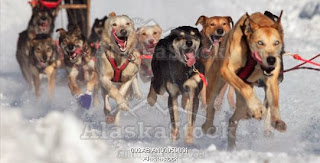
Alaska's history is filled with stories of its colorful past including the Native history, Russian culture, the gold rush era, and the early days of living in the "Last Frontier." However, one of the most unique icons of Alaska is Dog Mushing. Even today, residents still get asked if they mush to work!" The most famous event to result from this mushing history is the Iditarod - a 1,049 mile race from Anchorage to Nome. At Alaska Stock Images, you will find a wide variety of Alaska photos including dramatic Iditarod Photos. To find more pictures of Alaska or photos of the Iditarod, visit our search page.

Before the Iditarod race existed, dog mushing was simply a mode of transportation. In a country that is snow-filled and ice-covered more months out of the year than it is summer, mushing was an efficient mode of travel. Never was this clearer than in 1925 when a case of diphtheria broke out in Nome, Alaska. The only serum available was located in Anchorage. Although airplanes were considered, the only two available had been dismantled for the winter in Fairbanks. The decision was made to send the serum from Anchorage by rail as far as it could go which was Nenana. From their began the famous relay of mushers who brought the serum to Nome in about one weeks time using the already well established route known as the Iditarod. The longest stretch of the run was by Leonard Seppala who left Nome to meet the serum in Shaktoolik. He then turned around and passed in on to Charlie Olsen in Golovin. Having traveled a total of 260 miles in -30 degree temperatures, Seppala earned himself a place in the history books.

The idea of having a sled dog race to commemorate the life-saving serum run was first conceived by Dorothy G. Page in 1964 while working on a committee for the 1967 Alaska Centennial. Dorothy presented the idea to Joe Redington Sr. รข€“ a well known musher in the Knik area. With incessant promotion from Page and Redington, the first Iditarod race was held in 1967 with a purse of $25,000 and was a mere 27 miles long. By 1973, with the help from Alaska's National Guard, the entire historic trail had been cleared and the first 1,000 plus mile race was held. In 1983 that the official "start" was moved to Anchorage with a second "re-start" in Wasilla on the following day. The Iditarod race alternates each year between two routes - the northern and southern. This allows both sections of the historic trail to be utilized as well as provide the small villages equal opportunity on both routes to participate in the race. Although the most recognized and famous distance of the race is 1,049 miles, the actual distance varies each year and is in excess of 1,100 miles on odd numbered years using the southern route.
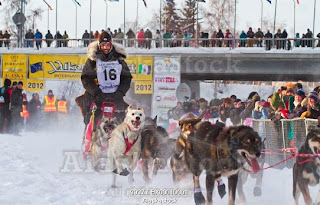

Although the Iditarod Race Committee has an annual budget of nearly two million dollars, the event relies heavily upon volunteers. The volunteers help on everything from sewing the thousands of dog booties to being checkers along the 20 plus checkpoints along the trail. The "Iditarod Airforce" is an all-volunteer fleet of pilots and their planes that shuttle supplies, veterinarians, other volunteers, food and even dogs to various locations along the trail. Volunteer veterinarians from across the nation and sometimes the world volunteer their time to participate. Volunteer trail breakers with their snow-machines keep the trail clear and marked for the mushers. The "logistics" staff in Anchorage is often made up of retired volunteers from the lower 48 who want to experience their little piece of the race and provide much assistance to keeping the most current information available to the public by answering phones and updating the Iditarod website. The "Official Iditarod Photographer," Jeff Schultz, has also volunteered his time for well over 20 years in pursuit of the ultimate documentation of the Last Great Race.

Although the Iditarod is a trek into the wilderness and is often a personal challenge as much as a race, the rules and regulations set forth by the Iditarod Committee are strict and designed to keep the dogs and mushers safe. Each musher and team must adhere to the following: Carry at all times a cold weather sleeping bag of at least 5 lbs, ax, snowshoes, eight booties for each dog (that's about 128 booties per musher and over 8,000 booties used for all teams!!), cooker and cookpot, three bottles of Heet (fuel), and 8 lbs of emergency food beyond the normal amount needed for the dogs. Dogs are examined regularly along the trail for signs of fatigue, illness, or injury. The dogs dine like kings during the race, wolfing down 5,000 calories or more each day. Their food includes lots of protein and fat. Some mushers make their own concoctions from ingredients like fish, hamburger, beef, horse meat, lamb, beaver, moose, caribou, and sometimes even seal meat.

A musher may start with as many as 16 dogs and must finish with at least five - none of which can be "added" to the team after the beginning of the race. Food, hay, and other supplies for dogs and mushers are shipped out to each checkpoint in advance, but it is entirely up to the musher to prepare, cook, and take care of his team. Any outside assistance other than in an emergency will disqualify a musher. An extensive list of rules (download PDF document) designed to provide a fair and safe race for both mushers and dogs are posted each year to the Iditarod website.

Regardless of the weather or trail conditions, the race always goes on. In 2003 when trail conditions were so bad due to an unseasonably warm winter, the race start was simply moved to Fairbanks - a first in the history of the race. This is another example of the long standing spirit of the race...regardless of what mother nature throws at you, the pioneering and adventurous spirit prevails. With vast amounts of unsettled space, treacherous conditions, and extreme temperatures, the Iditarod is a race only possible in Alaska!

As recently as 2009, in celebration of Alaska's 50th Anniversary of Statehood, the Iditarod was featured on the US Postal Service stamp honoring Alaska's Statehood. The photo taken by Jeff Schultz is of alpenglow colors reflecting off the mountains found in the Rainy Pass area with DeeDee Jonrowe mushing her way to Nome.

Recalling the many times she and Jeff Schultz have traveled the Iditarod trail together DeeDee remarked, "It is humbling to be part of the image chosen to represent Alaska as the U.S. Postage Service recognizes our beautiful states 50th birthday. I have been blessed to live my dreams for over a quarter of a century combining my love of my dogs, my passion for this beautiful state, and to experience adventure beyond my wildest imagination. Thanks to Jeff Schultz's god-given talent for capturing that on film, I now have the honor to celebrate this through this stamp."

Friday, December 6, 2013

Limited Time Promotion - Snowman!

Limited Time Promotion from Alaska Stock - Snowman Standing Next To A Stream Canvas Print. This is a short term offer at significant savings. Visit us on Fine Art America to learn more.

Limited Time Promotion

Tuesday, November 5, 2013

What Does The Fox Say?


The fox has a reputation as a smart and wiley creature. Its skills are so sharp that the fox has become a part of the English language with such phrases "sly as a fox," "outfoxed," and "crazy as a fox." However, it is believed that the fox is not necessarily so much smarter than other animals but its senses of sight, hearing, and smell are highly developed and contribute greatly to the fox's success.

The Red Fox is native to Alaska and found throughout much of the state with a few exceptions. Some islands in the Southeast and Alaska have foxes that were "introduced" during the early 1900's when fox farming was a popular means of income. During the 1920's, a fox pelt would sell for as high as $500. The fox prefers broken country, extensive lowland marshes, and crisscrossed hills and draws. The fox population is mostly south of the arctic tundra. The Red Fox will share territory with the Arctic Fox, but the Red Fox is dominant and can be territorial. In areas where the two overlap and conflict, Red Foxes have been observed digging Arctic Foxes from their dens and killing them.

The Red Fox is part of the dog family and measures between 22 and 32 inches (body length) with an additional 14-16 inch tail. Males are referred to as "dogs" and females as "vixens." Foxes breed in early spring, generally February or March. Their den is often a burrow that is left behind by small animals such as a marmot. When the fox moves in, it generally expands the size to approximate 15-22 feet and adds additional exits. The female fox lines its den with grass and after a gestation period of 53 days, gives birth to a litter of four to ten "kits" which are born blind. After about a month, the kits are old enough to leave the den and by three months they are learning to hunt. Both the male and female care for the kits for the length of the summer, but by autumn the parents and kits go their own separate way.

The fox is omnivorous which includes everything from plants and berries, to hares, squirrels, birds, eggs, and voles (their favorite). Fox will cache their excess food when hunting is good and return to the cache to either consume it or simply dig it up to make sure it is still where the fox left it.

In places where the fox is not often around humans, they show a cautious curiosity. However, where interaction is common, the fox shows little fear and can easily live in close proximity with humans. Foxes are quite vocal and have a large variety of howls, barks, and whines. The red fox has several natural enemies: man (principally as trappers), wolves, coyotes, lynx, wolverines, and perhaps bears. Eagles are the major predators of young foxes in some areas.

View more Red Fox photos at Alaska Stock.


Thursday, October 31, 2013


Alaska encompasses more than a half million square miles of land which includes glaciers, mountains, and tundra...and a large majority of it is inaccessible by vehicle or boat. To see some of the best parts of Alaska, you must take to the air!

One out of every 64 residents of Alaska has a pilots' license. Whether it is from the need to carry supplies to the far corners of Alaska or simply for the thrill of flying wild over a majestic land, Alaska has garnered six times as many pilots per capita than any other place in the US. The term "Bush Plane" is naturally derived from the phrase "The Bush" usually referring to the remote and most inaccessible areas of Alaska. These small planes are typically Navajos, Otters, Widgeons, Beavers, or Cessnas. Each plane type has its own personality and specialization. For example, the Dehavilland Beaver, often referred to as "The Beaver," is the workhorse of the bush planes. The Dehavilland Otter is known for its capacity and room to haul people and still be able to maneuver and land on small remote landing strips.

Some bush planes sport wheels to land on small airstrips. Others have floats to alight on the state's many small lakes and rivers. In winter, skis can be strapped to the bottom of the plane. Anchorage's Lake Hood is said to be the busiest seaplane base on earth. Similarly, Anchorage's Merrill Field claims to have more takeoffs and landings than any other small aircraft airfield. In many parts of Alaska, seeing or traveling by a small plane is almost as common as traveling by car.

Anchorage is sometimes referred to as the "Air Crossroads of the World." Anchorage's Ted Stevens International Airport sees hundreds of flights a day and has become a major gateway for incoming tourists headed to many of Alaska's destinations and a stopover or re-fueling point for international flights.

The two main jobs of bush planes are typically to act as either a taxi service or to haul supplies and gear to remote regions. Many air taxi's provide services to visitors for flight seeing or simply to get to a promising fishing hole or hunting camp. One of the more popular flight seeing opportunities is to view Mt. Mckinley. Thousands of tourists each year enjoy the majestic view of "The Great One" by taking off from nearby Talkeetna. Air taxis offer trips all around the mountain or even the opportunity to land on glaciers or at the popular "Base Camp" where tourists and climbers alike enjoy a magnificent view. The bush pilots job to haul gear can range from the mundane to the unusual. During the Iditarod, the "Iditarod Airforce" volunteers haul food, supplies, and even dogs to and from the various villages along the trail.

The job of a bush pilot has often been characterized as dangerous and fool hardy in the ever changing climate and oftentimes dangerous environment of Alaska. However, Alaska has recently adopted the "Medallion Foundation" which aims at reducing crashes and improving overall air safety. The biggest challenge is often fighting the "Bush Pilot Syndrome" which is the image of the adventure seeking, risk taking, flamboyant pilot that seems to always just barely escape catastrophe. Through rigorous training and education, the Medallion Foundation aims to reduce air incidents and keep Alaska skies safe.

To view more photos of Alaska bush planes and pilots, visit Alaska Bush Planes at www.AlaskaStock.com: http://bit.ly/1gyz9Rb